






















Single vs Dual Jacketed Glass Reactors and How to Match a Chiller
A jacketed glass reactor controls temperature through its jacket and the circulator feeding it. For crystallization, controlled cooling and low-temperature synthesis, the two main choices are whether the vessel has one jacket or two, and which recirculating chiller will drive it. Get both right and you hold setpoint, see your batch and protect the glass. Get them wrong and you have a fogged vessel, a chiller that never reaches temperature, or a cracked jacket. Here is how the parts work and how to match them.
How a Jacketed Glass Reactor Controls Temperature
The reaction vessel is surrounded by a glass jacket. A chiller or heater pumps thermal fluid through that jacket, and heat moves through the inner glass wall between the fluid and your batch. Glass is a modest conductor of heat, so there is always a temperature difference between jacket fluid and vessel contents. With good stirring the gap shrinks, but plan on the jacket running several degrees colder than the batch when you are cooling.
Everything outside the jacket matters too. The jacket's outer surface is exposed to room air, and so are the hoses. At sub-zero setpoints, the room is constantly adding heat that the chiller has to remove.
Single vs Dual Jacketed Reactor: What Is the Difference?
Single jacketed
A single jacketed reactor has one layer of fluid between the batch and the room. It is simpler and works well near room temperature or for moderate heating and cooling. The drawback shows up below the dew point of the room air: the outside of the jacket gets cold enough that moisture condenses on it, and well below 0 °C that turns to frost. You lose sight of the batch, water drips onto the stand and floor, and the chiller works harder because the outer glass is soaking up room heat. Insulation wraps help, and some single jacketed systems ship with one.
Dual jacketed
A dual jacketed reactor adds a second, outer jacket that is pulled under vacuum. Heat moves poorly across a vacuum because there is very little gas to carry it by conduction or convection. That does two things:
- Less heat gain. The thermal fluid is shielded from the room, so more of the chiller's capacity goes into the batch and the jacket fluid holds temperature better.
- Clear glass. The outermost surface stays near room temperature, so condensation and frost do not form and you can watch crystals form, phases separate or colour change.

Video: Reactor Ready™ - Vacuum Jacketed Vessels (Heidolph North America, YouTube)
| Feature | Single jacketed | Dual (vacuum) jacketed |
|---|---|---|
| Layers | Thermal fluid jacket only | Thermal fluid jacket plus outer vacuum jacket |
| Heat gain from room | Higher, unless wrapped | Lower |
| Condensation and frost below dew point | Likely | Kept off the outer glass |
| Visibility at low temperature | Reduced, especially with a wrap | Good |
| Extra hookup | None | Vacuum source for the outer jacket |
| Best fit | Near-ambient and moderate work | Sub-zero cooling, crystallization, long cold holds |
Our own Science King 50L Glass Reactor and Science King 100L Glass Reactor are both built this way, with an inner heating/cooling jacket and an outer vacuum jacket. Both run on 220 V single phase, with 3 phase available on request, and the 100L includes a stirring motor and condenser. For bench-scale work, the Ai 10L single or dual jacketed glass reactor comes in either configuration, so you can choose based on how cold you run. Its single jacket version includes an insulation jacket with a viewing window.
Glass Reactor Sizing and the Heat Load
Before picking a chiller, estimate how much heat you need to move. The sensible heat to cool a batch is mass × specific heat × temperature drop. A worked example for a 20L jacketed glass reactor holding a water-like liquid:
- 20 kg × 4.18 kJ/kg·K × 20 K (20 °C down to 0 °C) ? 1,670 kJ
- Spread over one hour, that is an average of about 465 W
- Cut the time to 30 minutes and you need about 930 W
On top of that, add the heat stored in the glass and jacket fluid, heat gained through the jacket and hoses, stirrer energy, and any heat released by the reaction or by crystallization itself. Exothermic steps can dominate everything else, so take them from your process data. Organic solvents generally have a lower specific heat than water, which lowers the sensible load per kilogram.
Remember that a chiller's cooling capacity falls as its setpoint drops. A rated range such as 600-2500 W covers the spread from cold to near-ambient operation, and the low end applies at the coldest temperatures. Size for the capacity available at your working temperature, not the headline figure.
How to Match a Recirculating Chiller for a Reactor
1. Temperature range
Pick a chiller whose lowest temperature is comfortably below the batch temperature you need. You lose degrees to the jacket-to-batch gap and to heat gain in the hoses. As a rule of thumb, leave at least 10-20 °C of margin. A process that holds a batch at -20 °C is much easier on a chiller rated to -40 °C or lower than on one rated to -25 °C.
2. Reservoir volume
When you start up, the chiller pushes fluid out to fill the jacket and hoses, and the reservoir level drops. The reservoir must cover that fill with fluid to spare so the pump never runs dry. The Ai 10L, for example, has a 3 L jacket. Larger reactors have much bigger jackets, so check the jacket volume and add the hose volume. A bigger reservoir also adds thermal mass, which smooths out temperature swings when you dose reagents.
3. Flow and pressure
Higher flow keeps the jacket fluid close to the chiller setpoint from inlet to outlet and improves heat transfer. But glass jackets have low pressure limits. The Ai 10L lists a maximum jacket pressure of 4.4 psi (0.03 MPa). A pump rated for 6 m of lift can generate roughly 0.6 bar (about 8.5 psi) with water against a restricted or closed line, which is more than that rating. Use a bypass or pressure-relief arrangement, never close valves on the return side while the pump runs, and check the reactor manual for its own limit.
Science King chiller options
| Model | Working range | Reservoir | Flow | Rated power / supply |
|---|---|---|---|---|
| -40 20L Recirculating Coil Chiller | -40 °C to room temperature | 20 L | 20 L/min | 1400 W, 220 V 60 Hz, 9 A max |
| -60 30L Coil Chiller | -60 °C to room temperature | 30 L | 50 L/min | 2200 W, 220 V 60 Hz, 16 A max |
Both list refrigerating capacity of 600-2500 W and 6 m of pump lift, need an indoor room kept between 5 and 35 °C, and do not run on a standard 120 V outlet. Note that both work from their low limit up to room temperature. If your process also needs heating, plan for a heater or heating circulator as well.
Practical Setup Tips
Tubing
- Keep hose runs as short as practical and use insulated hose. Every metre of bare hose adds heat and pressure drop.
- Use hose rated for your full temperature range. Many rubbers stiffen and crack at low temperatures.
- Secure every connection with clamps and support the hoses so their weight does not load the glass jacket nozzles.
- Feed the jacket from the bottom and return from the top so air is purged and the jacket fills completely.
Fluid choice
- Water and glycol mixtures are common for moderate sub-zero work. Mix to a freeze point well below your coldest setpoint.
- For the lowest setpoints, use a heat transfer fluid rated for that temperature. Check its viscosity at setpoint, because thick fluid cuts flow and heat transfer.
- Confirm the fluid is compatible with the chiller, hoses and seals. Avoid flammable fluids unless the whole setup is designed for them.
Treat the glass gently
Borosilicate 3.3 glass handles a wide temperature range, but sudden large changes cause stress and can crack a jacket or vessel. Do not send cold fluid into a hot jacket or the reverse. Ramp temperature in steps, avoid pouring cold liquid into a hot vessel, and follow the manufacturer's limits in the manual. On dual jacketed vessels, keep the outer jacket vacuum in place while running cold. Wear eye protection and gloves, and keep loose clothing and hair away from the stirrer.
Get Help Matching Your System
Every process has its own volume, setpoint and heat load. Tell us your batch size, solvent, target temperatures and timing, and we will help match a reactor and chiller to your process. Request a quote and our team will follow up.
Equipment in this guide
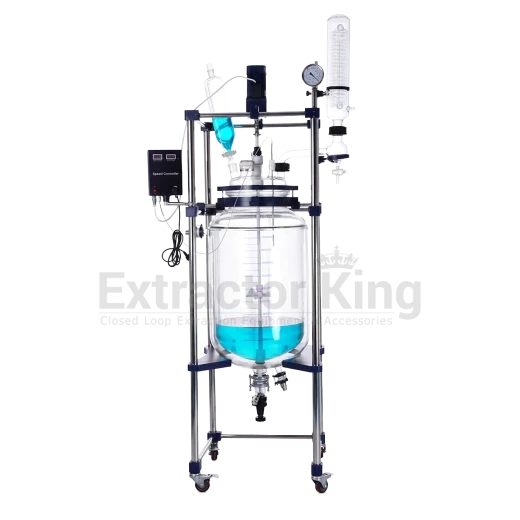 100L Glass Reactor - Science King
View product
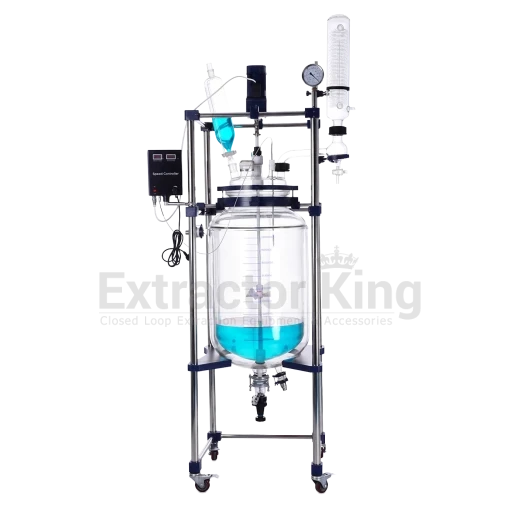 50L Glass Reactor - Science King
View product
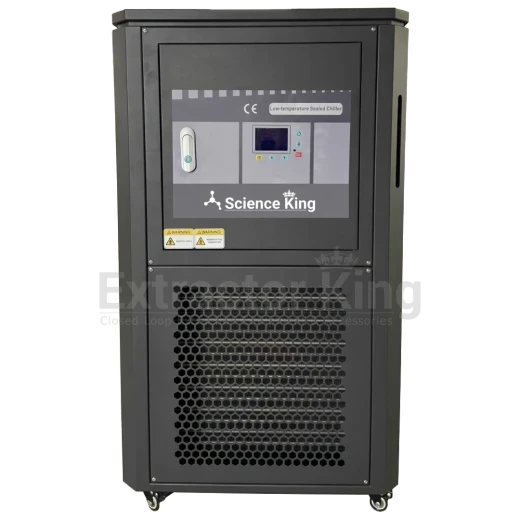 -40 20L Capacity 20L/M Recirculating Coil Chiller - Science King
View product
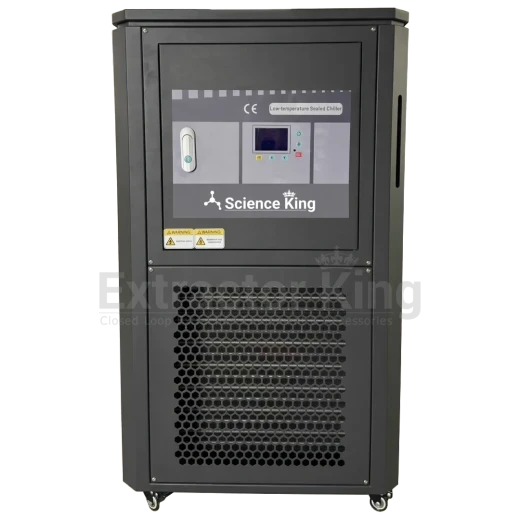 -60 30L Capacity 50L/M Coil Chiller - Science King
View product
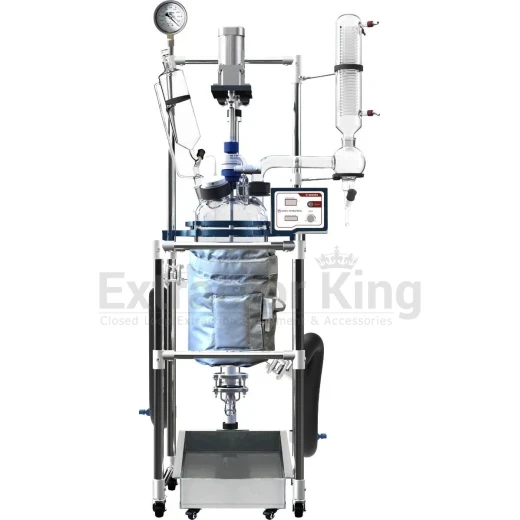 Glass Reactor Ai 10L Single or Dual Jacketed Systems
View product