

























Choosing a Heat Transfer Fluid for Your Chiller or Heated Circulator
The fluid in your chiller or heated circulator does the real work. It carries heat out of a reactor jacket, condenser or cold trap, or carries heat into it, and then returns to be cooled or reheated. The wrong heat transfer fluid for a chiller or circulator can freeze, turn too thick to pump, boil, smoke or degrade. The right one is easy to forget about. This guide covers how to match a fluid to your temperatures and equipment, and how to fill and change it safely.
How a Heat Transfer Fluid Works in the Loop
A recirculating chiller or heated circulator holds fluid in a reservoir, brings it to setpoint and pumps it out through hoses to your equipment, such as a jacketed reactor, a rotary evaporator condenser or a cold trap. The fluid picks up or gives off heat there and comes back. How well this works depends on three properties:
- Working range: the span of temperatures where the fluid stays liquid, stable and safe to handle.
- Viscosity: how thick the fluid is. This decides how easily the pump can move it and how well it transfers heat at the jacket wall.
- Heat capacity: how much heat each litre can carry. Water-based fluids carry more heat per litre than oils.
Before choosing a fluid, write down the coldest and hottest temperatures the loop will actually see. Those two numbers decide most of what follows.
The Working Range Must Cover Both Setpoints
A common mistake is choosing a fluid for the main setpoint and forgetting the other end of the process. A jacketed reactor might hold at -20 °C during a crystallization step and then warm to +80 °C for a dissolution or solvent strip. If one circulator and one fluid serve that reactor, the fluid has to be suitable at both temperatures, with some margin at each end.
Margin matters for two reasons. First, at the cold end, a fluid that is technically liquid near its lower limit is often very thick. Second, at the hot end, local surfaces such as heater elements run hotter than the bulk fluid. So choose a fluid whose published range sits comfortably outside your setpoints on both sides, not just touching them.
The equipment also sets limits. For example, the Science King -40 20L Recirculating Coil Chiller has a working range of -40 °C to room temperature, so the fluid in it only needs to perform from -40 °C up to ambient. The Science King 300 °C Heated Circulator can heat its bath to 300 °C, but that does not mean any fluid can go there. Water boils at 100 °C at normal pressure, so anything hotter needs an oil rated for the temperature you plan to run.
Why Low-Temperature Viscosity Matters
Every liquid gets thicker as it cools, and for many heat transfer fluids the increase is steep. When viscosity rises:
- Flow drops. The pump moves less fluid through the same hoses and jacket, especially over long hose runs or with a high lift.
- Heat transfer falls. Thick fluid tends to move in smooth layers along the jacket wall instead of mixing, so less heat crosses the wall.
- The pump works harder. More energy goes into pushing the fluid, and some of that ends up as heat in the loop.
The Calflo AF data shows how strongly temperature affects viscosity: 32.3 cSt at 40 °C, dropping to 5.4 cSt at 100 °C. Moving in the other direction, below room temperature, oils keep thickening. A fluid's pour point is the lowest temperature at which it will still pour. It is not a practical working temperature. Calflo AF has a pour point of -39 °C, which means it still flows when a system starts cold. That is useful for cold startups, but it does not make Calflo a low temperature bath fluid.
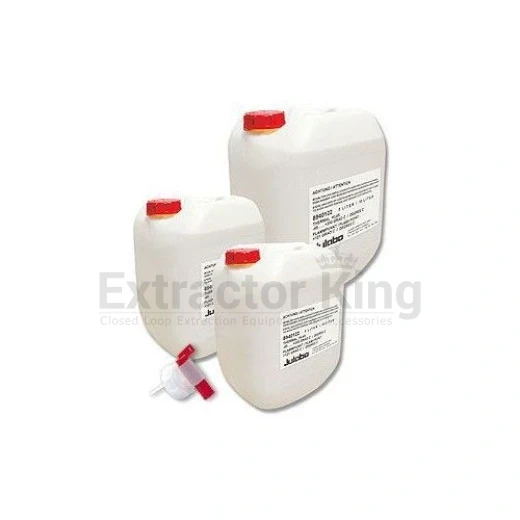
For a low temperature bath fluid, look for one designed to stay thin at your coldest setpoint. Julabo Thermal P90, for instance, is a 2 cSt silicone fluid, which is very thin.
Glycol vs Silicone Oil and Synthetic Fluids
Glycol and water mixes
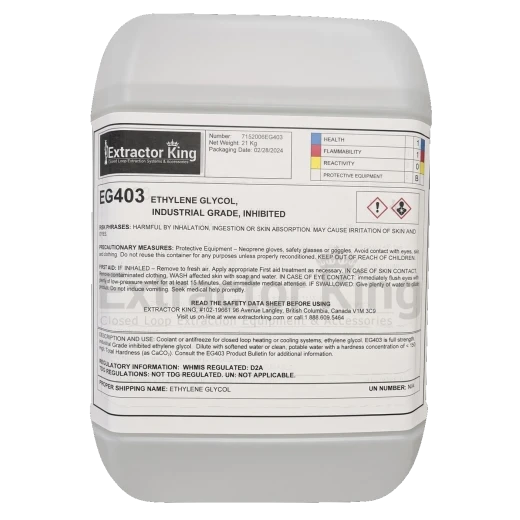
Inhibited ethylene glycol diluted with water is the standard choice for chillers running below 0 °C. The water gives good heat capacity, the glycol lowers the freezing point, and the inhibitors help protect metal parts in the loop. Our Extractor King Inhibited Ethylene Glycol, Industrial Grade is formulated for chillers and heating devices that need low temperatures to -50 °C. It is supplied full strength, as a yellow-green liquid with a pH of 10 ±0.5, in a 21 kg container.
The freeze protection you get depends on how much you dilute it, so follow the EG403 Product Bulletin for the mix ratio. Dilute with softened water, or with clean potable water with less than 150 mg/L total hardness (as CaCO3). Hard water can leave scale in the reservoir and jacket. Because the mix is water-based, it is not the fluid for high-temperature work in an open bath.
Silicone fluids
Silicone heat transfer fluids contain no water, so there is nothing to freeze out at low temperature or boil off near 100 °C. Low-viscosity grades stay thin when cold, which makes them popular for wide-range temperature control. They are system-specific, though. Julabo Thermal P90 has a published working range of -90 to +170 °C, but only inside a Julabo PRESTO unit, whose cold oil overlay lets the fluid run safely above its flash point. Julabo rates it for PRESTO units only, and it should not be used in an open bath. Always read the published range together with the conditions attached to it.
High-temperature heated circulator oil
For heating above 100 °C, a heated circulator oil designed for long hours at temperature is the usual choice. Calflo AF Heat Transfer Fluid is rated for bulk temperatures up to 316 °C (600 °F) in closed, non-pressurized, liquid-phase systems such as oil-heated jacketed reactors, heating circulators and process heaters. Its flash point (COC) is 217 °C (423 °F) and its autoignition temperature is 343 °C (649 °F). Keep those numbers in mind when you set heater limits and plan venting. In any setup where the oil is exposed to air, stay well below the flash point.
| Fluid | Published range or limits | Conditions |
|---|---|---|
| Extractor King Inhibited Ethylene Glycol | For low temperatures to -50 °C | Diluted with soft water per product bulletin; closed-loop heating or cooling |
| Calflo AF | Max bulk 316 °C; pour point -39 °C; flash point 217 °C | Closed, non-pressurized, liquid-phase systems |
| Julabo Thermal P90 | -90 to +170 °C | Julabo PRESTO units only; not for open baths |
Matching Fluid to Equipment: Quick Examples
- Chiller fluid for a jacketed reactor or condenser down to -40 °C: the Science King -40 chiller paired with an inhibited ethylene glycol mix diluted for your coldest setpoint. This chiller runs on 220 V, 60 Hz (maximum input 9 A), not a standard 120 V outlet.
- Gentle heating to 100 °C: the Science King 100 °C Heated Circulator has a 7 L stainless steel bath that takes water or oil and runs on 110 V or 220 V single phase.
- Heating a reactor jacket above 100 °C: the Science King 300 °C circulator, using its internal pump and hose barbs, with an oil rated well above your setpoint.
Safe Filling, Labelling and Changeover
- Read the SDS and manual first. For ethylene glycol, the supplier specifies neoprene gloves and safety glasses or goggles, and warns it is harmful by inhalation, ingestion or skin absorption. Keep it out of reach of children and pets.
- Fill cold and leave headspace. Fluids expand as they heat, and oils noticeably so. Fill to the manufacturer's mark with the unit off and cool, never to the brim.
- Check hoses and fittings. Use hose rated for the full temperature range and confirm with the fluid maker that your hose and seal materials are compatible. Secure every barb connection with clamps.
- Label everything. Mark the unit and the reservoir with the fluid name, mix ratio, fill date and the temperature limits you have set. Label any storage containers clearly, and do not reuse fluid containers unless properly reconditioned.
- Never mix fluid types. When changing from glycol to oil or between oils, drain completely using the drain hose or valve, flush per the manufacturers' advice and dry the system. Water left behind in an oil system can flash to steam and spit hot oil when heated past 100 °C.
- Inspect regularly. Darkening, sludge, a sharp odour or a change in viscosity are signs to change the fluid. Check pH and concentration on glycol mixes.
- Ventilate hot oil setups and keep ignition sources away, especially near flammable solvents.
Get Help Choosing
If you are not sure which fluid suits your temperatures, or whether your current chiller or circulator can cover both ends of your process, we can help match the fluid, temperature control unit and reactor to your work. Request a quote and tell us your setpoints, vessel size and hose run, and we will recommend a setup that fits.
Equipment in this guide
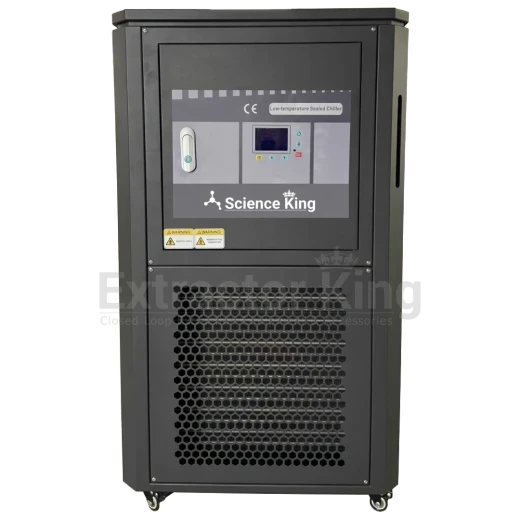 -40 20L Capacity 20L/M Recirculating Coil Chiller - Science King
View product
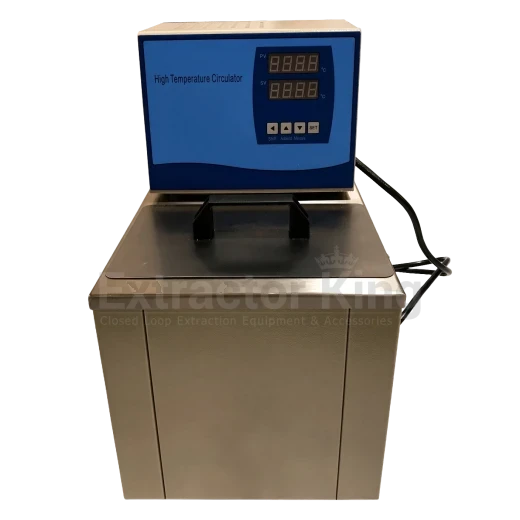 Heated Circulator 100°c Water or Oil Bath - Science King
View product
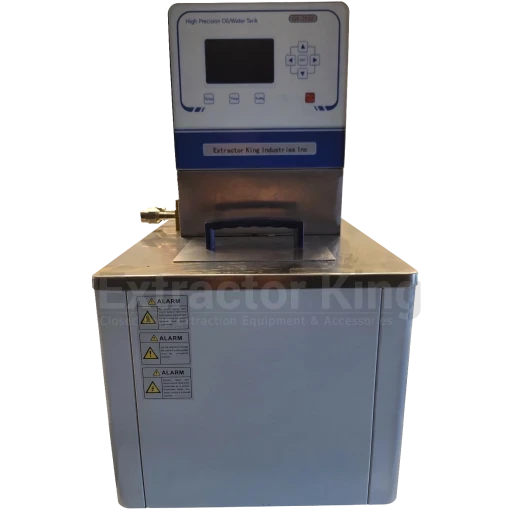 Heated Circulator 300° Celsius Oil & Water Bath - Science King
View product
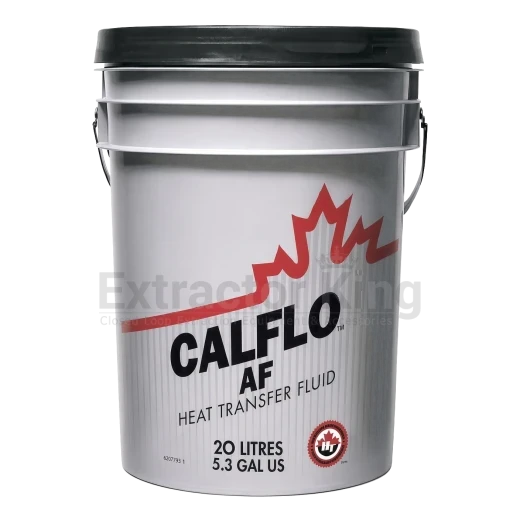 Calflo Heat Transfer Fluid 316°C (600°F) - 5 Gallon Pail (18.9 L)
View product
 Ethylene Glycol Inhibited Industrial Grade -50c
View product
 Julabo P90 -90°C to +170°C Thermal Bath Fluid - 10L
View product