






















Dry Scroll vs Rotary Vane vs Diaphragm Vacuum Pumps for the Lab
Most lab vacuum questions come down to three pump types: diaphragm, dry scroll and oil-sealed rotary vane. All three will pull a vacuum on a rotary evaporator, a distillation setup or a vacuum oven. They do it in very different ways, and that changes how deep they go, how they cope with solvent vapour and what you spend your time maintaining. This guide explains how each one works, then matches them to common jobs, with real catalogue examples so you can compare data sheets side by side.
How Each Pump Creates Vacuum
Diaphragm pumps
A diaphragm pump uses a flexible membrane driven up and down by a motor and eccentric. As the diaphragm pulls back, gas is drawn into the head through an inlet valve. As it pushes forward, the gas is forced out through an outlet valve. There is no oil and no sliding contact in the gas path, so nothing needs lubricating.
The limit on depth comes from the small dead volume left in the head at the end of each stroke and the valves themselves. That is why diaphragm pumps bottom out in the millibar range rather than going deep. For many solvent jobs that is all you need.
Dry scroll pumps
A scroll pump has two interleaved spirals. One is fixed; the other orbits without rotating. Gas is trapped in crescent-shaped pockets at the outer edge and squeezed toward the centre as the orbit continues, then exhausted. Polymer tip seals on the spiral edges close the gap between the scrolls.
Because the compression is gradual and continuous, a scroll pump reaches far lower pressures than a diaphragm pump while still keeping the vacuum path oil-free. The main wear part is the tip seal set.
Oil-sealed rotary vane pumps
A rotary vane pump has an off-centre rotor spinning inside a cylindrical stator. Vanes slide in and out of slots in the rotor, sweeping gas from the inlet around to the exhaust. A film of oil seals the tiny clearances, lubricates the vanes and carries away heat. That oil seal is what lets a vane pump reach deep vacuum in a compact package.
The trade-off is that the oil is exposed to everything you pump. Solvent vapour can dissolve in it, water can condense in it, and acids can attack it. Contaminated oil raises the pump's base pressure and shortens its life, so oil condition becomes a regular maintenance task.
Side-by-Side Comparison
| Diaphragm | Dry scroll | Rotary vane | |
|---|---|---|---|
| Oil in gas path | No | No | Yes |
| Typical depth | Millibar range | Hundredths to thousandths of a millibar | Deep vacuum, well below 1 mbar |
| Solvent vapour | Good with chemically resistant heads; solvent can be recovered at outlet | Good on chemical-resistant models, with gas ballast | Needs a cold trap and gas ballast; solvent ends up in oil |
| Routine service | Diaphragms and valves | Tip seals | Oil changes, plus vanes and seals over time |
| Best fit | Rotovaps, filtration | Distillation, drying, clean vacuum | Vacuum ovens, freeze drying, degassing |
What the Differences Mean in Practice
Ultimate pressure: how deep do you really need?
Rotary evaporation rarely needs deep vacuum. You set a pressure that brings the solvent's boiling point down to a comfortable bath temperature. Water, for example, boils at 40 °C at about 74 mbar, and lower-boiling solvents need even less vacuum. A pump that reaches around 10 mbar covers most rotovap work.
Short path and other high-temperature distillations are different. Heavy essential oil fractions and high-boiling compounds often need pressures well below 1 mbar to distil without being cooked. That is scroll or rotary vane territory. When people ask for the best vacuum pump for distillation, the honest answer is: one whose ultimate pressure sits comfortably below your target, with speed to match your system volume and leak rate.
Solvent vapour handling
For a chemical resistant vacuum pump, look at what the gas actually touches. A PTFE gas path in a diaphragm pump, or chemical-resistant valves and fittings in a scroll pump, will tolerate solvent vapour far better than standard materials. Gas ballast, which bleeds a small amount of air into the compression stage, helps stop condensable vapours from turning to liquid inside scroll and vane pumps.
Whatever the pump, a condenser or cold trap between the process and the pump protects it and lets you recover solvent instead of exhausting it.
Oil changes and service parts
An oil free vacuum pump for the lab saves you from draining and disposing of contaminated oil. Diaphragm pumps need occasional diaphragm and valve replacement; scroll pumps need tip seals. A rotary vane pump needs fresh oil on a schedule set by what you pump, and more often when solvents are involved. Watch the oil colour and change it before it darkens or thins.
Catalogue Examples to Compare
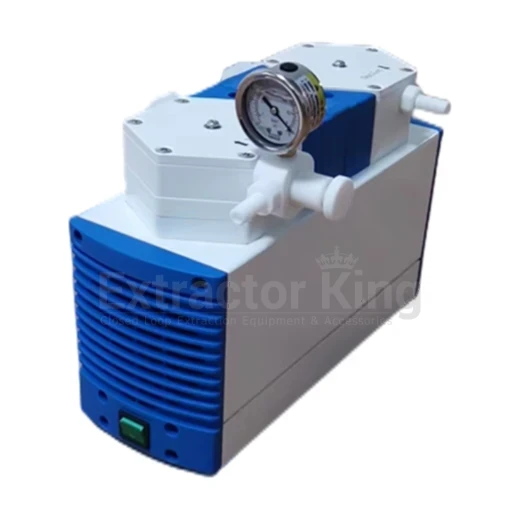
Diaphragm: Science King B-Series
For a diaphragm vacuum pump for rotovap work, start with our Science King B-Series PTFE diaphragm vacuum pumps. Every part the gas touches is PTFE, and they are oil-free and water-free, so solvent can be recovered at the outlet. There are four models:
- B20 and B40: 20 and 40 L/min, ultimate vacuum 8–10 mbar, vacuum gauge included. Suited to rotovaps up to about 5 L and suction filtration.
- B60 and B80: 60 and 80 L/min, ultimate vacuum 10–18 mbar. Suited to 10–50 L rotovaps and distillation.
They are rated for continuous running and have a thermal switch that stops the pump if it overheats and restarts it once cool. Note that they run on 220 V 60 Hz, not a standard 120 V outlet, and they are not for areas that require explosion-proof equipment.
If several people need vacuum at once for rotovaps or filtration, the Science King SHB-B95 water ring vacuum pump is another oil-free option: five independent taps at 10 L/min each, 80 L/min total, a maximum vacuum of -0.098 MPa and a 50 L water tank in a polypropylene body.
Dry scroll: Edwards nXDS10iC and Agilent IDP-7
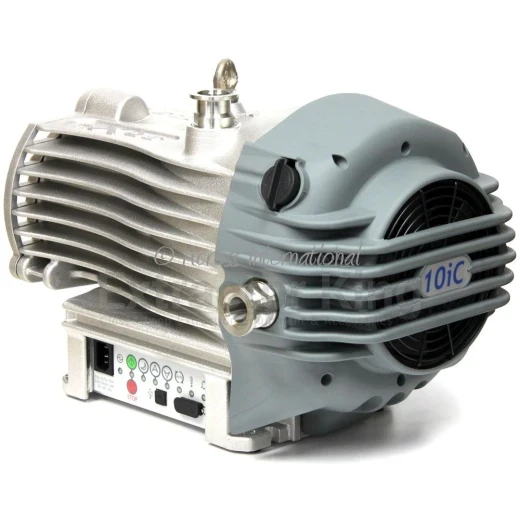
When you need deeper, oil-free vacuum, the Edwards nXDS10iC chemical-resistant dry scroll pump is built for vapour work. It has Chemraz internal valves, stainless steel fittings and gas ballast for condensable vapours. Key data sheet numbers:
- Ultimate vacuum 0.007 mbar (5 micron)
- Peak pumping speed 11.4 m³/h
- Maximum water vapour pumping rate 145 g/h, maximum inlet pressure for water vapour 35 mbar
- Maximum continuous inlet pressure 200 mbar
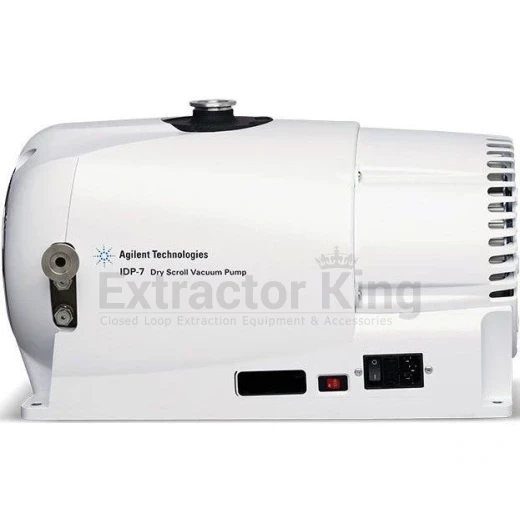
For clean, dry vacuum on instruments or small process setups, the Agilent IDP-7 dry scroll pump peaks at 152 L/min and reaches 2.0 x 10⁻² Torr at 60 Hz. Its tip seals change from one side in about 15 minutes with simple tools. It is described as a clean-vacuum pump rather than a chemical-resistant model, so keep a good cold trap ahead of it on solvent work.
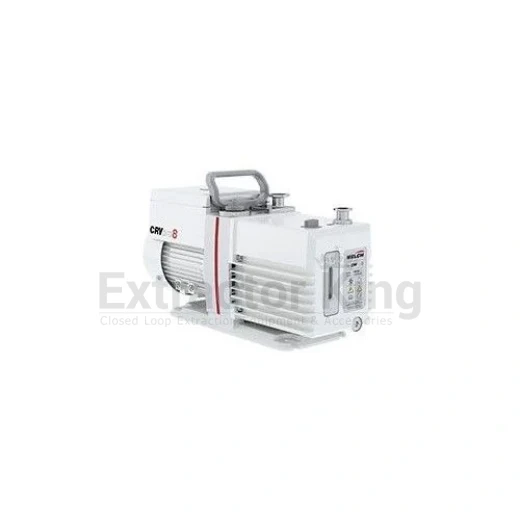
Rotary vane: Welch CRVPro 8
The Welch CRVPro 8 direct drive rotary vane pump is aimed at freeze drying, degassing, vacuum ovens and concentrators. It has gas ballast, forced oil lubrication, an anti-suckback mechanism and thermal overload protection. Welch states it has a 40% larger oil capacity than comparable pumps to dilute aggressive chemicals, and a chemical-resistant coating in the oil case and pump module. One important limit: Welch does not recommend direct drive pumps for filtration or other uses requiring sustained operation above 30 torr, which rules out long rotovap runs at moderate vacuum.
Matching a Pump to Your Process
- Rotary evaporation of common solvents: a PTFE diaphragm pump sized to your flask and condenser.
- Short path or high-vacuum distillation: a chemical-resistant dry scroll pump with a cold trap, or a rotary vane pump if you accept oil maintenance.
- Vacuum oven drying and freeze drying: a rotary vane or scroll pump, with a trap to keep moisture and solvent out.
- Multi-user filtration: a multi-tap water ring pump or a diaphragm pump.
Safety Notes
Vent pump exhaust to a fume hood or outside, especially with flammable solvents. Check the voltage before you plug in. Inspect vacuum glassware for chips and star cracks before every run, and wear eye protection. Keep liquids and solids out of every pump inlet, and read the manufacturer's manual before first use.
Not sure which pump suits your rotovap, still or oven? Request a quote and tell us about your solvents, volumes and target pressure. We will help you match a pump and the right trapping to your process.
Equipment in this guide
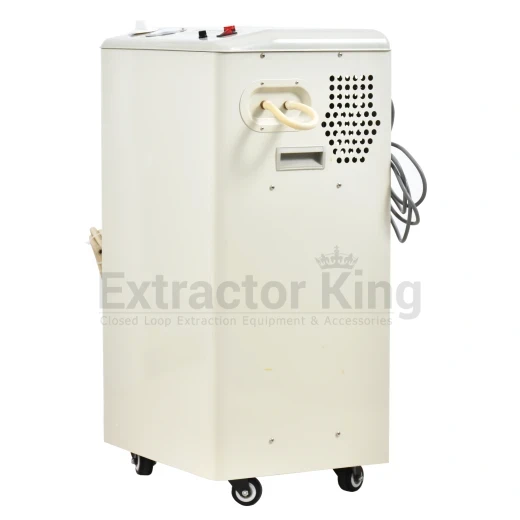 SHB-B95 Water Ring Vacuum Pump (5 Taps, 50L Tank) - Science King
View product
 B-Series PTFE Diaphragm Vacuum Pumps, 20–80 L/min - Science King
View product
 Welch 5.6 CFM CRVPro 8 Direct Drive Rotary Vane Vacuum Pump
View product
 Edwards nXDS10iC 7.5 cfm Chemical-Resistant Dry Scroll Pump
View product
 Agilent IDP-7 5.4 cfm Oil-Free Compact Dry Scroll Pump
View product