























Falling Film vs Wiped Film Evaporators for Solvent Recovery
If you recover ethanol or other solvents from large volumes of flavour and botanical extracts, a rotary evaporator eventually becomes the bottleneck. The next step up is a thin film evaporator. The two designs you will hear about most are the falling film evaporator and the wiped film evaporator. Both spread liquid into a thin layer on a heated surface so solvent evaporates quickly. They do it in different ways, though, and that difference decides what each one is good at.
This guide explains how each works, how they handle feed viscosity, residence time and throughput, and how to match them to your feed and to whatever happens to your concentrate next.
Why a Thin Film Helps Solvent Recovery
Evaporation happens at the liquid surface, and heat has to travel through the liquid to get there. In a deep pool, such as a flask or kettle, the liquid at the bottom sits on the heated wall for a long time while the surface does most of the evaporating. A thin film changes this in two ways:
- Faster heat transfer. With only a thin layer between the hot wall and the vapour space, heat reaches the evaporating surface quickly.
- Less time at temperature. Each portion of liquid passes over the heated surface once and leaves. That matters for flavour and aroma compounds that degrade or change with prolonged heating.
Running under vacuum lowers the boiling point of the solvent, which lets you use a gentler heating temperature again. Both falling film and wiped film systems are normally run this way.
How a Falling Film Evaporator Works
In a falling film evaporator, feed enters at the top of a vertical heated surface, usually one or more tubes. A distributor spreads the liquid so it runs down the inside walls as a continuous film. Gravity does the work: there are no moving parts inside the evaporator.
As the film flows down the heated wall, solvent boils off. Vapour and the remaining liquid travel down together and separate at the bottom. The vapour goes to a condenser and becomes recovered solvent; the concentrated liquid drains out as product.
Strengths and limits
- High throughput. Because the design is simple and continuous, it scales well for removing large volumes of solvent.
- Short, single-pass heating. Liquid is on the heated surface only while it flows down, far shorter than a batch sitting in a heated vessel.
- Best with thin, free-flowing feeds. Gravity needs the liquid to flow and wet the wall evenly. As the feed gets more concentrated and viscous, the film thickens, flows unevenly and can leave dry spots that foul or scorch.
In practice, a falling film evaporator is ideal for the bulk of the job: taking a dilute extract with a lot of ethanol and removing most of that ethanol quickly.
How a Wiped Film Evaporator Works
A wiped film evaporator uses a heated vertical cylinder with a motor-driven rotor inside. Feed enters at the top, and wiper blades or rollers on the rotor mechanically spread the liquid into a thin, constantly renewed film on the heated wall. The wipers keep pushing the film along and mixing it, so it does not rely on the liquid flowing well on its own.
Volatile components evaporate and travel to a condenser. The less volatile material continues down the wall and leaves as residue. Depending on the job, your product is either the distillate or the residue. In short path or molecular designs the condenser sits very close to the evaporating surface, which allows separation at very deep vacuum.

Video: Pfaudler Wiped Film Evaporator (WFE) - Construction and Operation (GMM Pfaudler, YouTube)
Strengths and limits
- Handles viscous feeds. Mechanical wiping keeps a uniform film on liquids too thick for a falling film unit.
- Very short residence time. Material is typically on the heated wall for only seconds, which protects heat sensitive compounds.
- Deep vacuum capability. Suitable for stripping the last traces of solvent and for distilling high boiling point compounds.
- Lower throughput per unit of size compared with a falling film unit stripping a thin feed, plus a rotor, drive and seal to maintain.
Thin Film Evaporator Comparison
| Factor | Falling film | Wiped film |
|---|---|---|
| How the film forms | Gravity, via a top distributor | Motor-driven wipers on a rotor |
| Feed viscosity | Low; dilute, free-flowing extracts | Low to high; concentrates and oils |
| Residence time | Short, single pass | Very short, typically seconds |
| Throughput | High; built for bulk solvent removal | Lower; built for finishing and separation |
| Moving parts inside | None | Rotor, wipers, drive seal |
| Typical role | First-stage ethanol recovery | Final solvent stripping, distillation of concentrates |
Matching the Technology to Your Feed
Ask two questions: how much solvent is in your feed, and what do you need to do with the concentrate afterwards?
Large volumes of dilute ethanol extract
If your extraction line produces hundreds or thousands of litres of ethanol-rich extract a day, a falling film evaporator is the right ethanol recovery equipment for the first stage. Our Science King Stainless Steel Falling Film Evaporator is built in stainless steel for continuous feed and discharge, and recovers up to 150 L of ethanol per hour (about 40 US gallons). Running around the clock, that is roughly 3,600 L of ethanol a day. It runs on 220V single phase, with 3 phase available on request.
Viscous concentrates or residual solvent
Once most of the ethanol is gone, the concentrate thickens and a falling film unit is no longer the best tool. A wiped film evaporator takes over for stripping remaining solvent and for distilling or purifying the concentrate itself, such as separating essential oil fractions or purifying botanical extracts.
- The Science King FMD-250 Stainless Steel Molecular Distillation system has SUS316 stainless steel contact parts, evaporation areas from 0.05 m² to 5 m² depending on model, magnetic sealing on the wiper drive and a diffusion pump reaching ? 0.001 mbar. It is designed for high boiling point, heat sensitive and easily oxidizable substances.
- The 12" Stainless Steel Wiped Film Distillation System is a turnkey production unit with an approximately 0.97 m² evaporation area, a jacketed 5 cc gear pump for continuous feed, three circulators, and a TRP-90 two-stage rotary vane pump with a diffusion pump.
- For smaller production, the MWFD-5L Molecular Wiped Film Distillation System is food grade stainless steel with no glass parts in the evaporator, a peristaltic auto-feed pump for continuous operation, and a heated condenser coil that needs no chiller.
Using both in series
Many production lines use both: a falling film evaporator removes the bulk of the ethanol at high throughput, then a wiped film system finishes the concentrate. Each unit works where it performs best, and the wiped film system is not tied up evaporating large volumes of solvent it was never sized for.
Practical Setup and Safety Notes
- Flammable solvents. Ethanol vapour is flammable. Install in a well-ventilated area, keep ignition sources away and follow your local fire and building requirements.
- Electrical supply. Confirm your available power before ordering. Larger systems may need dedicated circuits or 3 phase service.
- Vacuum. Inspect seals, fittings and any glass receivers regularly, and never run damaged components under vacuum.
- PPE and training. Use heat-resistant gloves and eye protection, and have operators read the manual before first startup.
Get Help Sizing Your Solvent Recovery System
The right solvent recovery system depends on your solvent, daily volume, feed viscosity and what happens to the concentrate next. Tell us about your process and we will help you match the equipment to it. Request a quote and our team will follow up with full specifications for your setup.
Equipment in this guide
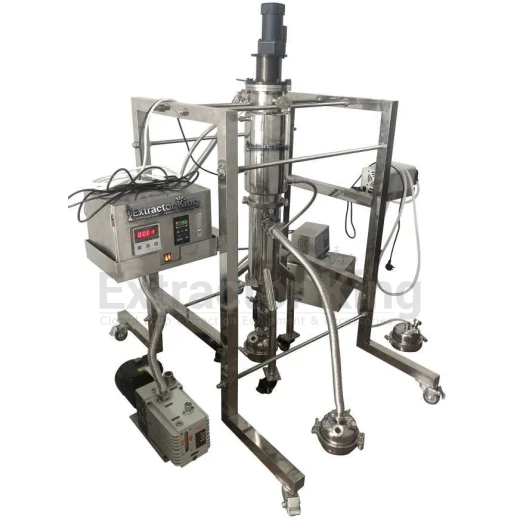 MWFD-5L Molecular Wiped Film Distillation System (Turn Key) - Science King
View product
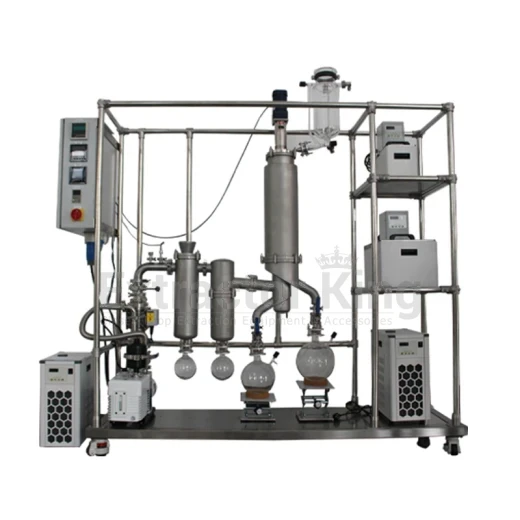 FMD-250 Stainless Steel Molecular Distillation (Wiped Film Evaporator) - Science King
View product
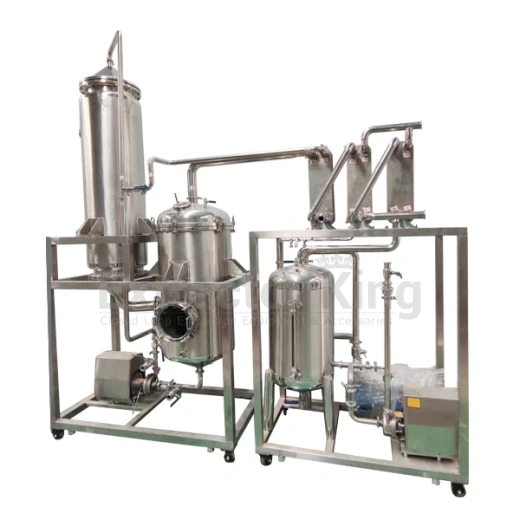 Stainless Steel Falling Film Evaporator - Science King
View product
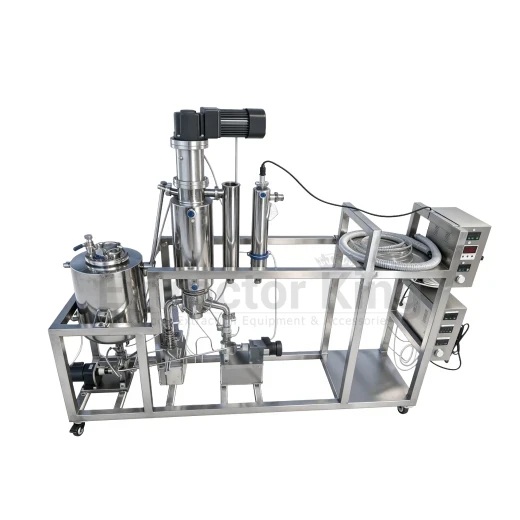 12" Stainless Steel Wiped Film Distillation System (Turnkey) - Science King
View product