




















Choosing a Rotary Evaporator Size: 2L, 5L, 10L, 20L or 50L?
Rotary evaporator size is one of the first decisions on any quote, and one of the easiest to get wrong. Buy too small and the unit becomes a bottleneck. Buy too large and you pay for bench space, power and glassware you never fill. This guide explains how a rotovap actually removes solvent, why the number on the flask is not your working volume, and how to match a 2L, 5L, 10L, 20L or 50L system to your batches for solvent recovery, essential oil concentration and flavour work.
How a Rotary Evaporator Works
A rotary evaporator spins a flask of solution partly submerged in a heated bath while the system is under vacuum. Rotation spreads a thin film of liquid over the inside of the flask, which increases the surface area for evaporation and keeps the contents mixing so they heat evenly. Vacuum lowers the boiling point of the solvent, so it evaporates at a gentle bath temperature. The vapour travels through a vapour duct to a chilled condenser, turns back to liquid and drains into a receiving flask.
Three systems work together: the heated bath supplies energy, the vacuum pump sets the boiling point, and the chiller removes that energy again at the condenser. The rotovap is only as fast as the weakest of the three.
Why Usable Volume Is Less Than Flask Size
A 20L flask does not hold a 20L batch. Most operators fill an evaporating flask to roughly half, and some manufacturers set a hard limit. For example, the Ai SolventVap 2L Rotary Evaporator specifies a maximum load not to exceed 60% of the flask's capacity.
There are good reasons for the headroom:
- Bumping and foaming. Solutions can boil suddenly or foam under vacuum. Space above the liquid keeps material out of the vapour duct and condenser.
- Film area. A partly filled flask spreads a larger film per litre of liquid, which evaporates faster than a full, sluggish flask.
- Weight and balance. A full large flask puts more load on the drive, seals and glass.
The good news: flask size does not cap your batch. The Science King units have direct injection capability for continuous feeding, so you can draw more solution in as the level drops. Your real limit becomes evaporation rate and receiving flask capacity, not the boiling flask.
What Controls Evaporation Rate
Bath temperature
Heat drives evaporation, and the rate depends on the temperature difference between the bath and the boiling solvent. A widely used starting point is the 20/40/60 guideline: bath at about 60 °C, solvent vapour at about 40 °C, condenser coolant at about 20 °C or lower. Each step keeps roughly a 20 °C gap so heat flows in at the bath and out at the condenser.
Vacuum level
Ethanol boils at 78 °C at atmospheric pressure. Under vacuum it boils far lower; at roughly 175 mbar it boils near 40 °C. Water needs deeper vacuum, around 70 to 75 mbar, for the same 40 °C boiling point. More vacuum is not always better, though. Pull too hard and vapour is generated faster than the condenser can handle, solvent slips past to the pump, and delicate aroma compounds in essential oils and flavour extracts can be carried over. A vacuum controller lets you hold a set point instead of simply running the pump flat out.
Condenser cooling
Every litre of solvent you evaporate has to be condensed again. If the chiller is undersized or the coolant too warm, pressure climbs, boiling slows, and uncondensed vapour reaches the pump. When you scale up the flask, the chiller must scale with it. Condensing area matters too, which is why larger units add a second condenser.

Video: Rotary evaporation and vacuum basics (VACUUBRAND GMBH + CO KG, YouTube)
Rotary Evaporator Sizes Compared
Rated evaporation figures are measured under specific conditions and are a guide, not a guarantee. Your rate will depend on solvent, vacuum, bath setting and chiller capacity.
| Model | Evaporating flask | Receiving flask | Rated ethanol rate | Power |
|---|---|---|---|---|
| Ai SolventVap 2L | 2L | 1L | 20 mL/min (about 1.2 L/h) | 110V, 1,340 W |
| Science King 5L | 5L | 3L | ? 4 L/h | 220V single phase, 2.2 kW, NEMA 6-20 |
| Science King 10L | 10L | 5L | ? 8 L/h | 220V single phase, 3.8 kW, NEMA L6-30 |
| Science King 20L | 20L | 10L | ? 12 L/h | 220V single phase, 4.3 kW, NEMA L6-30 |
| Science King 20L Dual Condenser | 20L | 2 × 10L | 16 L/h | 220V single phase, 6 kW heating |
| Science King 50L | 50L | 20L | ? 19 L/h | 220V single phase, 6.4 kW, NEMA L6-30 |
| Science King 50L Dual Condenser | 50L | 2 × 20L | 35 L/h | 220V single phase, 9 kW heating |
Which Size Fits Your Batches?
2L: method development and small samples
The Ai SolventVap 2L suits R&D labs concentrating a litre or so at a time, trialling a new essential oil or flavour concentration step, or working with small fractions. It runs on a standard 110V supply and fits on a bench, with a rotation range of 20 to 280 rpm and an ultimate vacuum below 3 torr.
5L: pilot work and a few litres per run
The Science King 5L Rotary Evaporator is a sensible step up for labs processing several litres per shift. At a rated ethanol capacity of at least 4 L/h, a 15 to 20 litre day is realistic with continuous feeding. Note that it needs 220V single phase with a NEMA 6-20 receptacle.
10L: small production and routine solvent recovery
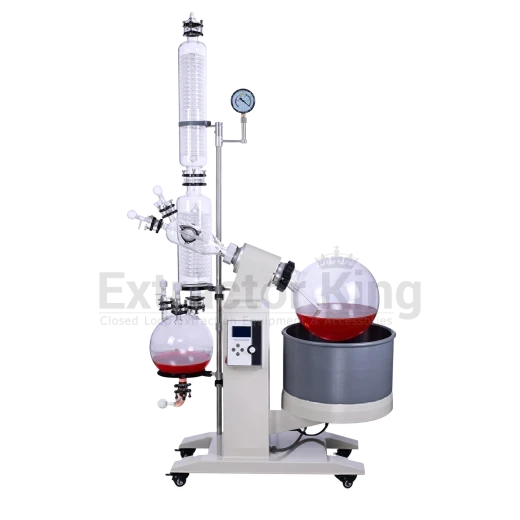
The Science King 10L Rotary Evaporator adds an auxiliary condenser and doubles the rated ethanol capacity to at least 8 L/h. It is a common choice as a rotary evaporator for ethanol recovery when daily volumes reach a few tens of litres but floor space is limited.
20L: production-scale recovery
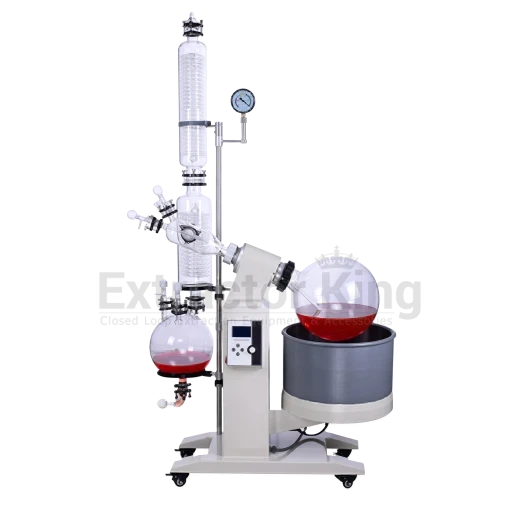
A 20L rotary evaporator is where many production teams settle. The Science King 20L Rotary Evaporator is rated at 12 L/h or more for alcohol and collects into a 10L receiving flask. Plan for its height: it stands 83 in. (about 2.1 m) tall. If throughput matters more than footprint, the 20L Dual Condenser model (R1020) adds a secondary condenser and two 10L collection flasks, with a manual vacuum valve so you can discharge without losing vacuum.
50L: high-volume solvent recovery
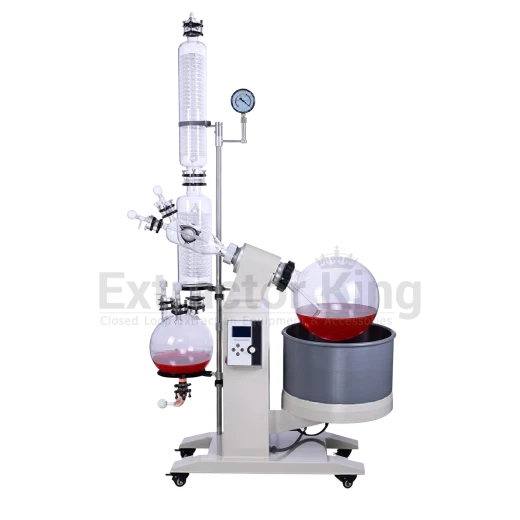
For 50L rotovap solvent recovery, the Science King 50L Rotary Evaporator is rated at 19 L/h or more for alcohol. The 50L Dual Condenser Rotary Evaporator (R1050 Dual) is rated at 35 L/h for ethanol and 15 L/h for water, with 1.86 m² of main and 1.04 m² of secondary condensing area and two 20L collection flasks. At this size the chiller and vacuum pump become major purchases in their own right, and your electrical supply needs checking before delivery.
Questions to Answer Before You Buy
- What volume do you process per day, and per batch? Divide daily litres by the hours you can run to get the evaporation rate you need.
- Which solvents? Water evaporates much more slowly than ethanol on the same unit; the R1050 Dual, for example, is rated at 15 L/h for water versus 35 L/h for ethanol.
- How heat-sensitive is your product? Delicate aromatics favour lower bath temperatures and controlled vacuum, which reduces rate.
- Do you have the chiller and vacuum pump capacity? Budget for both; the evaporator alone will not reach its rated output.
- What power is available? Above 2L, these units need 220V single phase with specific receptacles. Have a qualified electrician confirm the circuit.
- How much room do you have? Check ceiling height and floor space, especially for 20L and 50L frames.
- Do you need continuous collection? Dual receiving flasks let you drain recovered solvent without stopping the run.
Safety Notes
Ethanol and most extraction solvents are flammable. Run evaporators in a well-ventilated area away from ignition sources, inspect glassware for chips and star cracks before every vacuum run, and keep hair, sleeves and jewellery clear of rotating parts. Wear eye protection and gloves, and read the manufacturer's manual before first use.
Get Help Sizing Your System
If you are weighing two sizes, or need the evaporator, chiller and vacuum pump matched as a set, tell us your solvents, daily volumes and available power. Request a quote and our team will help match the right equipment to your process.
Equipment in this guide
 10L Rotary Evaporator - Science King
View product
 20L Rotary Evaporator - Science King
View product
 50L Rotary Evaporator - Science King
View product
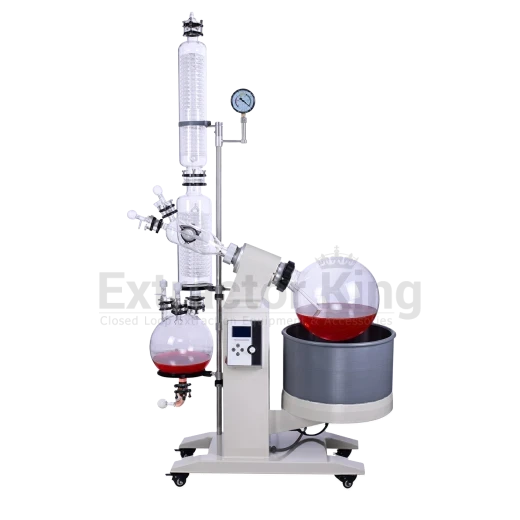 5L Rotary Evaporator - Science King
View product
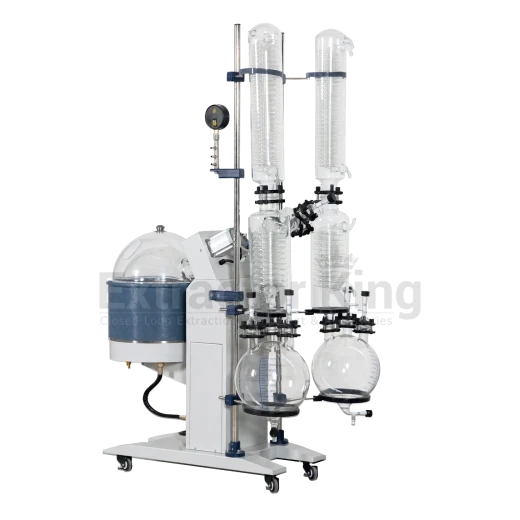 20L Dual Condenser Rotary Evaporator (R1020 Dual) - Science King
View product
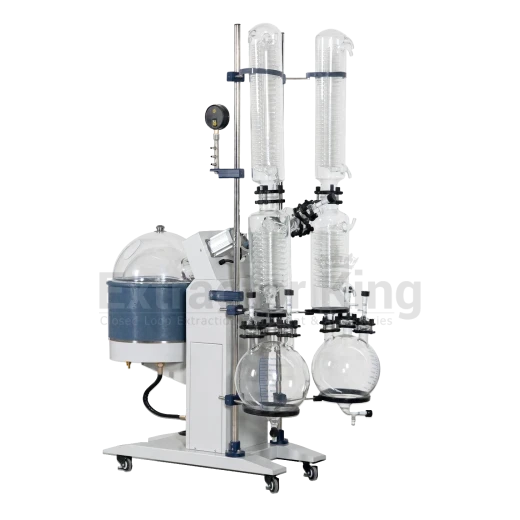 50L Dual Condenser Rotary Evaporator (R1050 Dual) - Science King
View product
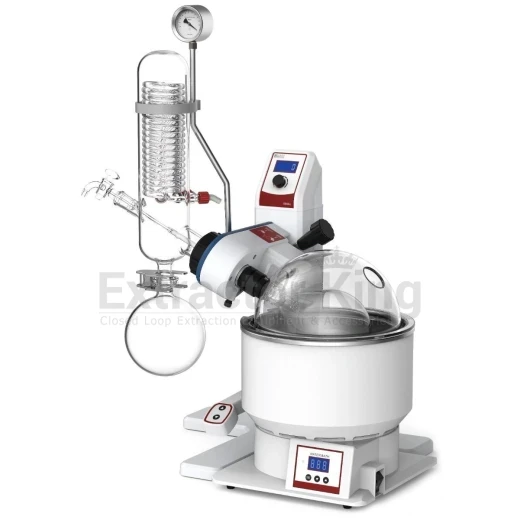 Ai SolventVap 2L Rotary Evaporator with Electric Flask Lift 110V
View product