























Short Path vs Wiped Film Distillation: Which Suits Your Process?
If you purify essential oils, flavour extracts or other natural products, you will eventually ask whether to start with a glass short path kit or invest in a wiped film system. Both are vacuum distillation tools that separate compounds by volatility. They differ in how long your material sits on a hot surface and how much of it you can process in a shift. Here is how each one works, where each makes sense and what you need around them.
The Principle Both Share: Vacuum Lowers Boiling Points
A liquid boils when its vapour pressure equals the pressure above it. Lower the system pressure and the boiling point drops. That is why high-boiling, heat-sensitive compounds are distilled under deep vacuum. You get them into the vapour phase at a temperature well below where they would darken, polymerize or oxidize at atmospheric pressure.
Both methods also keep the vapour path short. At very low pressures, every bend, narrow joint and long tube adds pressure drop between the evaporating surface and the condenser. A short path keeps the pressure at the hot surface close to what your gauge reads. When pressure is low enough and the gap to the condenser is small enough that vapour molecules reach the condenser with few collisions, the process is often called molecular distillation. The term is widely used for essential oils and other high-value natural products.
How Short Path Distillation Works
A short path distillation kit is a batch setup. You charge a round bottom boiling flask, usually heated in a stirring mantle, and pull vacuum. As the temperature rises, fractions boil off in order of volatility. They pass through a compact distillation head, often with Vigreux indentations for a little extra separation, and condense on a cooled jacket. The condensed liquid drops into receiving flasks that you switch between fractions.
The strengths are simplicity, visibility and low entry cost. You can watch the boil, see colour changes between fractions and make cuts by head temperature. The limitation is residence time. The whole charge stays hot for the full run, often several hours. The last material to distill has been heated longest, and the residue left in the flask has seen the most heat of all. For robust oils this is fine. For delicate top notes or easily oxidized compounds, that heat history can show up as darker colour or off-notes.
Typical short path kits
The Ai 2 Liter Short Path Distillation Kit with Valved Adapter is a sensible bench-scale start. It includes a heavy wall, vacuum jacketed distillation head with Vigreux and a cooling channel, a 2-neck boiling flask, two 500 mL receiving flasks, a valved adapter, a lab jack and a digital thermometer, all in borosilicate 3.3 glass. For larger batches, the Ai 5 Liter Short Path Distillation Kit follows the same design with a 5 L head, a 34/45 boiling flask joint and a larger 6 x 6" lab jack.
Wiped Film Evaporator: How It Works
A wiped film (thin film) evaporator is continuous. Feed is metered into the top of a heated vertical cylinder under vacuum. A rotating wiper assembly spreads it into a thin film on the inside wall. The film moves down the heated surface, and the more volatile components evaporate and travel to a condenser. The less volatile residue keeps flowing down and leaves through its own outlet. Distillate and residue are collected separately and continuously, and either one can be your product.
The key difference is heat exposure. Each portion of feed spends only a short time on the hot wall, typically measured in seconds rather than hours, before it is either evaporated or discharged. A thin, constantly renewed film also transfers heat efficiently, so you can run high throughput without holding a large volume at temperature.

Video: Pfaudler Wiped Film Evaporator (WFE) - Construction and Operation (GMM Pfaudler, YouTube)
You control separation with four main variables: wall temperature, vacuum level, feed rate and wiper speed. Once these are dialled in for a given feed, the system runs at steady state. That makes results more repeatable from batch to batch than hand-cut short path fractions.
Short Path vs Wiped Film Distillation at a Glance
| Factor | Short path (batch) | Wiped film (continuous) |
|---|---|---|
| Operation | Batch, fractions cut by hand | Continuous feed, steady state |
| Heat exposure | Whole charge hot for hours | Seconds on the heated wall |
| Throughput | Limited by flask size and run time | Set by feed rate and evaporation area |
| Fractionation | Multiple cuts in one run | One split per pass; repeat passes for more fractions |
| Construction | Glass | Typically stainless steel |
| Best fit | R&D, method development, small batches | Production, heat-sensitive feeds, repeatability |
When Each Makes Sense
Start with short path if
- You are developing methods, testing new botanicals or making samples for customers.
- Your batches are small and irregular.
- You need several fractions from one charge and want to see them separate.
- Your material tolerates a few hours at temperature without noticeable degradation.
Move to a thin film distillation system if
- You are processing the same feed repeatedly and short path runs are taking whole shifts.
- You see colour or aroma loss that points to heat damage.
- You need consistent output from run to run.
- You want continuous or unattended feeding.
Many processors keep both: short path glass for R&D and a wiped film unit for production.
Our Wiped Film Systems
The MWFD-5L Molecular Wiped Film Distillation System is a turnkey stainless unit with no glass parts in the evaporator. The heating range is RT +5°C to 300°C, wiper speed is 133 to 467 RPM, and a peristaltic pump feeds from 0.007 to 870 mL/min for continuous auto feed. Vacuum comes from a 21 CFM pump plus a diffusion pump. Its condenser coil runs heated at about 80°C, so no chiller is needed. That suits higher-boiling distillates. Lighter compounds collect in the SS304 cold trap, so strip solvents and light ends before feeding.
For sized-to-order systems, the FMD-250 Stainless Steel Molecular Distillation system has SUS316 contact surfaces and evaporation areas from 0.05 m² to 5 m², depending on model. It uses magnetic sealing on the wiper drive and a diffusion pump to ? 0.001 mbar. It is intended for high boiling point, heat-sensitive and easily oxidized substances.
At production scale, the 12" Stainless Steel Wiped Film Distillation System offers about 0.97 m² of evaporation area. It comes with a jacketed 5 cc gear pump feed, three separate circulators and a TRP-90 two-stage rotary vane pump backed by a diffusion pump.
Supporting Equipment Both Need
- Solvent removal first. Residual extraction solvent or water causes bumping in glass and unstable vacuum in a wiped film. Strip it on a rotary evaporator before distilling.
- A suitable vacuum pump. Use a two-stage rotary vane pump at minimum. Add a diffusion pump for molecular distillation pressures. Change pump oil regularly.
- A cold trap between the still and the pump to protect the oil from volatiles.
- Temperature control. A heating mantle for short path, plus a recirculating chiller or heater for condensers and jackets wherever the design calls for one.
- An accurate vacuum gauge. You cannot reproduce a separation without knowing your real pressure.
On safety: inspect glassware for stars and chips before every vacuum run, use only vacuum-rated glass, work in a ventilated area when handling flammable solvents, confirm your electrical supply matches the equipment, wear eye protection and gloves, and read the manual before first use.
Get Help Matching Equipment to Your Process
Not sure whether your oil, extract or feed belongs in a short path kit or a wiped film system? Tell us about your material, batch size and goals. We will help match the equipment to your process. Request a quote and our team will follow up.
Equipment in this guide
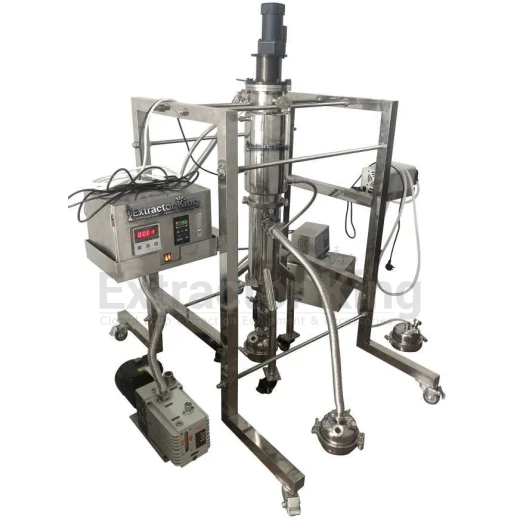 MWFD-5L Molecular Wiped Film Distillation System (Turn Key) - Science King
View product
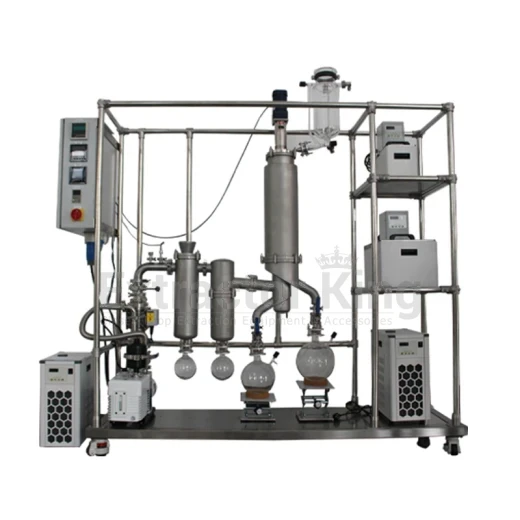 FMD-250 Stainless Steel Molecular Distillation (Wiped Film Evaporator) - Science King
View product
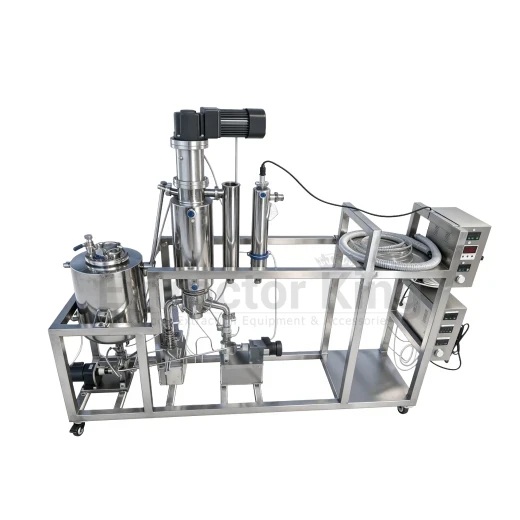 12" Stainless Steel Wiped Film Distillation System (Turnkey) - Science King
View product
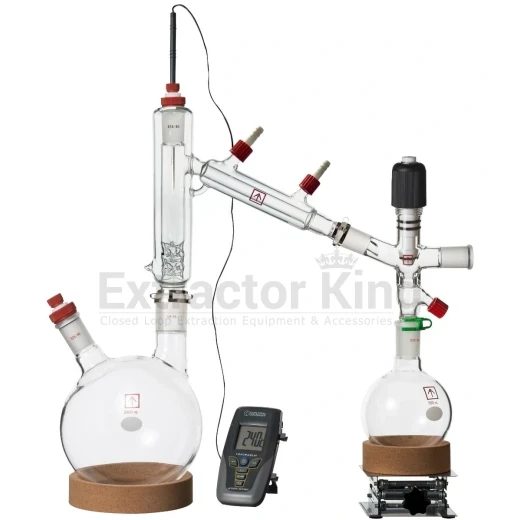 Ai 2 Liter Short Path Distillation Kit with Valved Adapter
View product
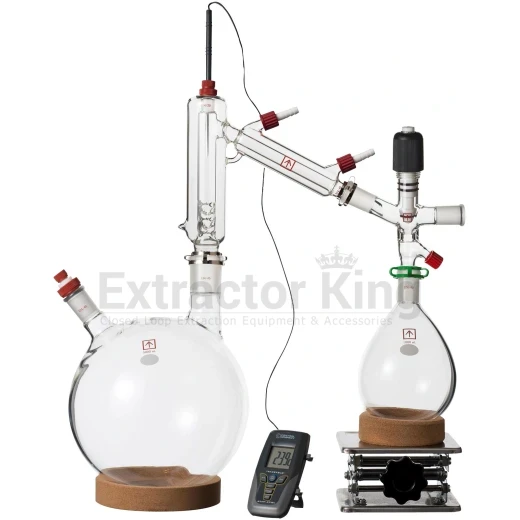 Ai 5 Liter Short Path Distillation Kit with Valved Adapter
View product