





















From Crude Extract to Clear Distillate: How Botanical Oils Are Purified
A crude plant extract is a mixture: the oils and aromatic compounds you want, plus waxes, fats, pigments, leftover solvent, water and plant sugars that you don't. Turning that crude extract into a clear, consistent, refined oil is a sequence of separation steps, each one removing a different kind of impurity. Skip a step, or do them in the wrong order, and the next step struggles.
This guide follows that sequence from start to finish, as it is used for essential oils, flavour extracts and other botanical concentrates, and explains which equipment does each job.
Step 1: extraction
Everything starts with pulling the target compounds out of the plant material. Ethanol is the most common solvent for botanical work because it is effective, food-safe in the right grades, and easy to recover. Other routes include supercritical CO2, steam distillation (the classic method for many essential oils) and mechanical pressing.
Whichever method you use, the result is a crude extract that still carries a lot of unwanted material. How cleanly you extract decides how much work the later steps have to do. Cold solvent and short contact times pull less wax and chlorophyll; see our guide Removing Chlorophyll and Colour from Botanical Extracts for more on that.
Step 2: winterization (removing waxes and fats)
Plant waxes and fats dissolve in warm ethanol but come out of solution when it gets very cold. Winterization uses that:
- Dissolve the crude extract in ethanol.
- Chill the solution well below freezing (commonly ?20 °C or colder) and hold it there, typically for 24 to 48 hours. The waxes and fats solidify into a cloudy precipitate.
- Filter the cold solution to remove the solids, working quickly or with chilled equipment so the waxes don't redissolve.
For small batches, a chilled Buchner funnel and flask are enough. For production, a jacketed reactor connected to a chiller holds the solution at temperature and drains straight to filtration: the Science King 50L Glass Reactor or 100L Glass Reactor, or the 100L Jacketed Stainless Steel Reactor for heavier duty, paired with a Science King chiller that reaches well below winterization temperatures, such as the ?60 °C 30L or ?80 °C 50L recirculating chiller. For filtering, a multi-funnel table such as the Infinity Stainless Steel Winterization Filter Table speeds things up.
This is also the natural point to pass the solution through adsorbent media to remove colour and polar impurities, while everything is still dissolved in solvent.
Step 3: solvent recovery
Next, the ethanol comes off so it can be reused, leaving a concentrated oil. A rotary evaporator does this under vacuum at low temperature, which protects heat-sensitive compounds. For lab and pilot volumes, a 20L unit such as the Science King 20L Rotary Evaporator is the usual workhorse, and the Science King 50L Dual Condenser Rotary Evaporator handles bigger batches with extra condensing capacity. Large daily volumes are better served by a continuous unit like the Stainless Steel Falling Film Evaporator, which strips solvent from a constant feed instead of batch by batch.
Step 4: degassing
Even after solvent recovery, the oil still holds traces of solvent, water and very light volatile compounds. If they go straight into a high-vacuum still, they boil off violently, the vacuum level swings, and separation suffers. Degassing is a gentle pre-step: warm the oil under moderate vacuum, often while stirring, until it stops bubbling. Many operators do this in the distillation flask itself, or as a first low-temperature pass through a wiped film unit.
Step 5: distillation
Distillation separates compounds by how easily they evaporate. Under deep vacuum, boiling points drop dramatically, so target compounds can be vaporized at temperatures low enough to avoid heat damage. The vapour travels to a cold condenser, turns back into liquid and is collected, while heavy, non-volatile material (pigments, polymers, salts, residual plant matter) stays behind.
A run is collected in fractions:
- Heads: the lightest compounds, which come over first.
- Main body: the refined target fraction.
- Tails and residue: the heavier compounds, plus what never evaporates.
For higher purity, the main body can be distilled a second time.
Short path distillation
In a short path set-up, the oil is heated in a round-bottom flask under deep vacuum, and the vapour travels only a few centimetres to the condenser. That short path is what makes high-vacuum distillation of heavy oils practical. Short path is a batch process, ideal for R&D, small production and high-value fractions. Kits range from the Ai 2L Short Path Kit and Ai 5L Short Path Kit up to the Ai 10L Short Path Complete Turnkey Package with chiller and pump included. A packable distillation head adds separation stages when two fractions boil close together.
Wiped film distillation
Wiped film (also called thin film or molecular) distillation feeds the oil continuously onto the inside of a heated cylinder, where rotating wipers spread it into a thin film. Each drop of oil spends only seconds on the hot surface, which is far gentler on heat-sensitive compounds than hours in a heated flask. Distillate and residue leave through separate outlets, so the unit runs continuously. One wiped film system can handle the throughput of many short path set-ups. Options include the MWFD-5L Molecular Wiped Film Distillation System, the FMD-250 Stainless Steel Molecular Distillation unit and the 12? Stainless Steel Wiped Film Distillation System for production scale.
Which one?
- Short path: lower cost, flexible, best for small batches, development work and fine fractionation.
- Wiped film: continuous, high throughput, gentlest on heat-sensitive oils, best once volumes are steady.
Many facilities use both: wiped film for the bulk passes, short path for small specialty runs.
The equipment list, in order
- Extraction system for your chosen method
- Jacketed vessel and chiller for winterization
- Filtration (Buchner funnels, filter table) and adsorbent media
- Rotary evaporator or falling film evaporator for solvent recovery
- Short path or wiped film distillation, with a deep-vacuum pump and chiller
Getting the sequence right
Each step makes the next one easier. Good winterization means fewer waxes fouling the still. Thorough solvent recovery and degassing mean a stable vacuum and sharper fractions. If your distillate is cloudy, off-colour or inconsistent, the cause is often upstream, not in the still.
Planning a new process or scaling up an existing one? Tell us your feedstock, your target product and your daily volume, and we will put together a matched set of equipment. Request a quote and we will reply with options.
Equipment in this guide
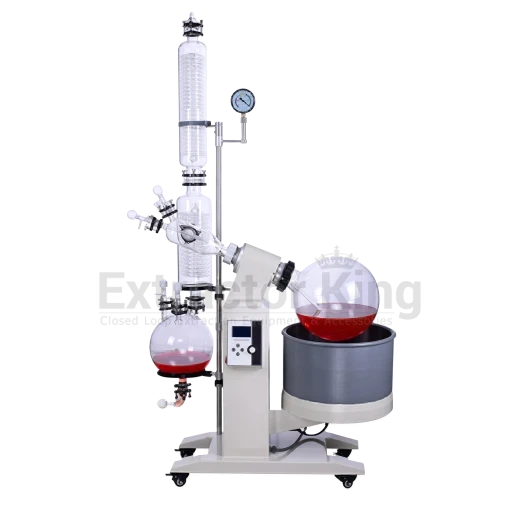 20L Rotary Evaporator - Science King
View product
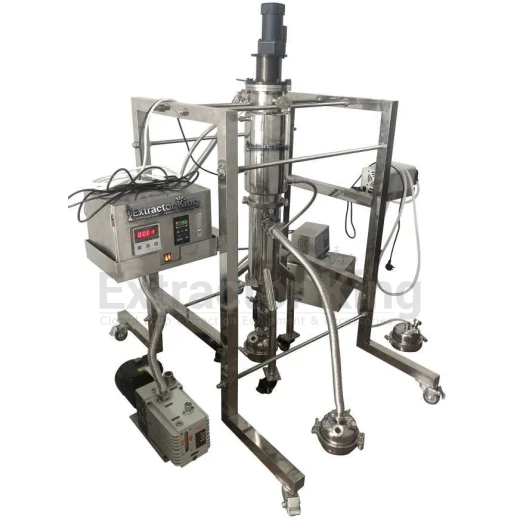 MWFD-5L Molecular Wiped Film Distillation System (Turn Key) - Science King
View product
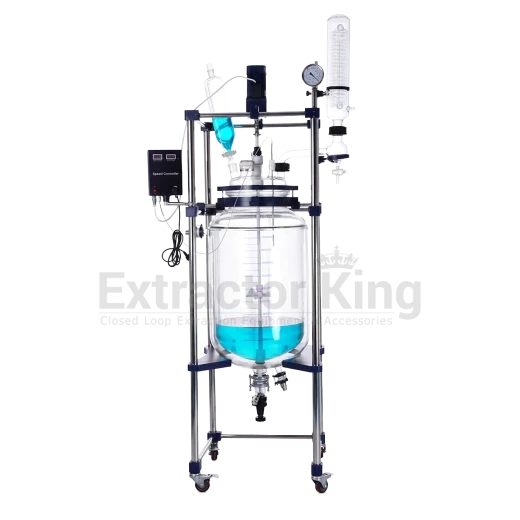 100L Glass Reactor - Science King
View product
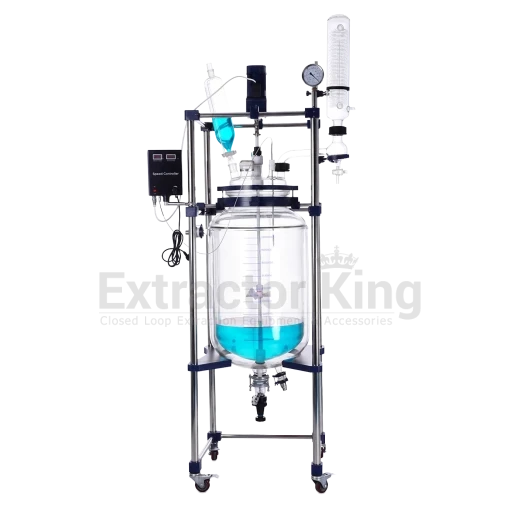 50L Glass Reactor - Science King
View product
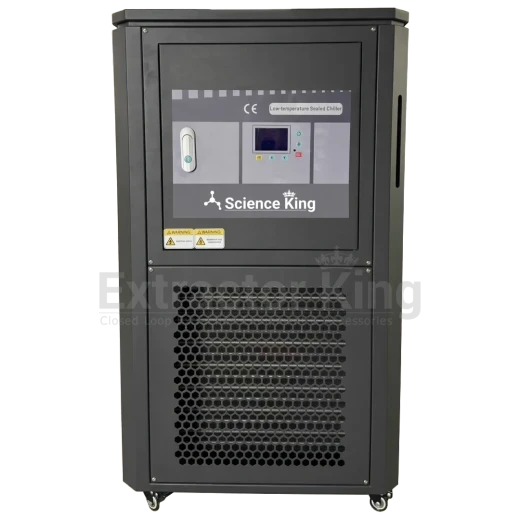 -60 30L Capacity 50L/M Coil Chiller - Science King
View product
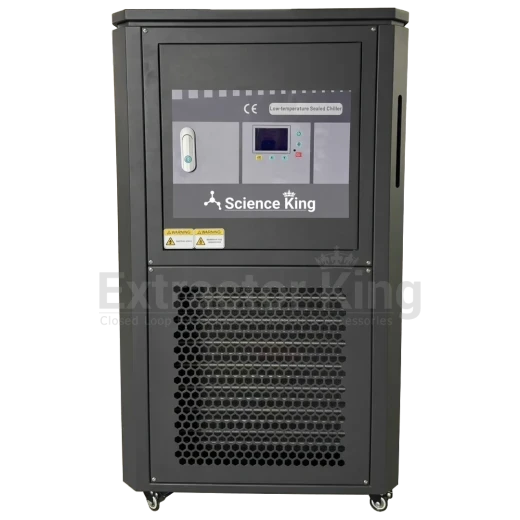 -80 50L Capacity 50L/M Coil Chiller - Science King
View product
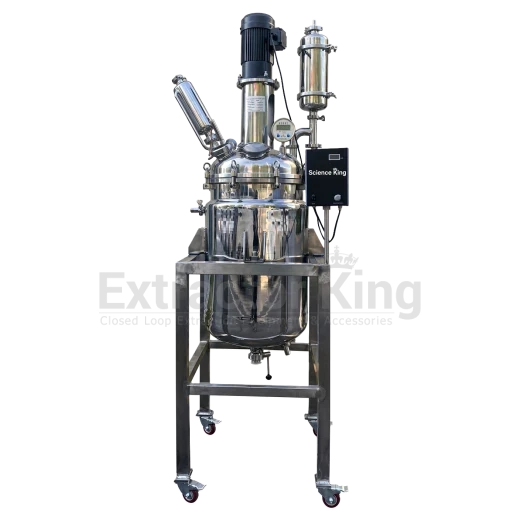 100L Jacketed Stainless Steel Reactor - Science King
View product
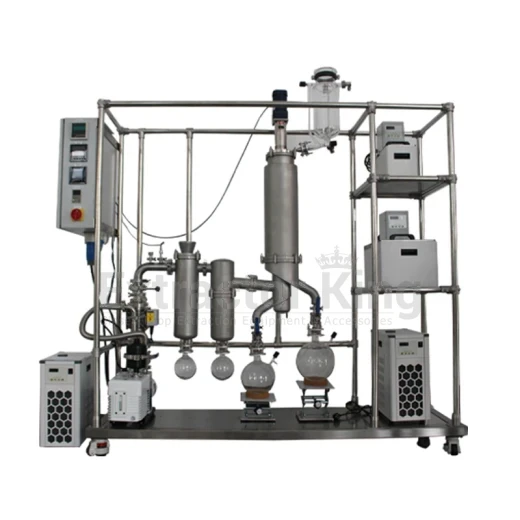 FMD-250 Stainless Steel Molecular Distillation (Wiped Film Evaporator) - Science King
View product